
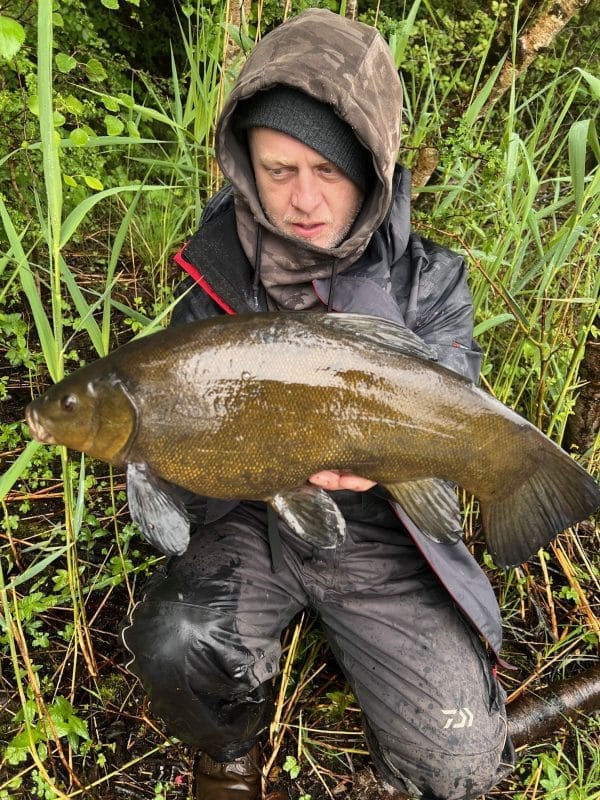
 Tench(Tinca Tinca)
Record 8lb 15oz taken on 20.06.1995 by Nick Parry at Ballyeighter Lake.
Specimen 6lb, or 2.722 kilo, or 52 cm fork length
Identification
Tench have a rotund body shape, with large pelvic fins, a small dorsal fin and thick, muscular tail. The under-belly is light in colour and can be a variety of colours from deep yellow and orange to pale cream. The flanks are deep olive green, or sometimes green-bronze. The eyes are small and bright orange-red in colour. The scales are extremely small and the skin is smooth to touch. The pelvic fins in adult males are thick and spoon-shaped. There are two small barbules either side of the mouth.
The tench is native throughout much of Europe and northern Asia, but it is not native to Ireland. Although it is an introduced species, tench are considered benign as they have no significant impact on native species or ecosystems. They are believed to have been introduced to Ireland during the Middle Ages to farm as food in fishponds at monastic settlements, but they were frequently redistributed to angling waters, resulting in a patchy distribution around the country. They are quite a hardy fish and can tolerate both short periods out of water if kept wet and low oxygen conditions.
Tench have small red eyes and a dark green, rather stocky body that is covered with small scales and mucus. The tench is sometimes called the “doctor fish”, a name that comes from an old belief that its mucus has healing properties for other fish that rubbed against them. Males can be recognised by their curved, spoon-shaped pelvic fins on their belly, whereas those of female tench are longer and more triangular. Spawning occurs over the summer on aquatic plants in shallow areas when water temperatures are high.
Tench are a shoaling fish and inhabit lakes, canals and slow-flowing rivers, feeding on invertebrates, zooplankton, algae and molluscs on the bottom amongst aquatic vegetation. A trail of bubbles on the surface of still waters can be a sign that tench are feeding on the bottom. Coarse anglers value tench as a strong, hard-fighting fish that is associated with dense weed beds and lily pads.


